Yukon & the North
Whitehorse: 10 Things to Do in the Yukon Capital
10 things to do in Whitehorse with 2026 prices and hours in CAD: Miles Canyon, the fish ladder, MacBride Museum, Beringia, Wildlife Preserve, hot springs.
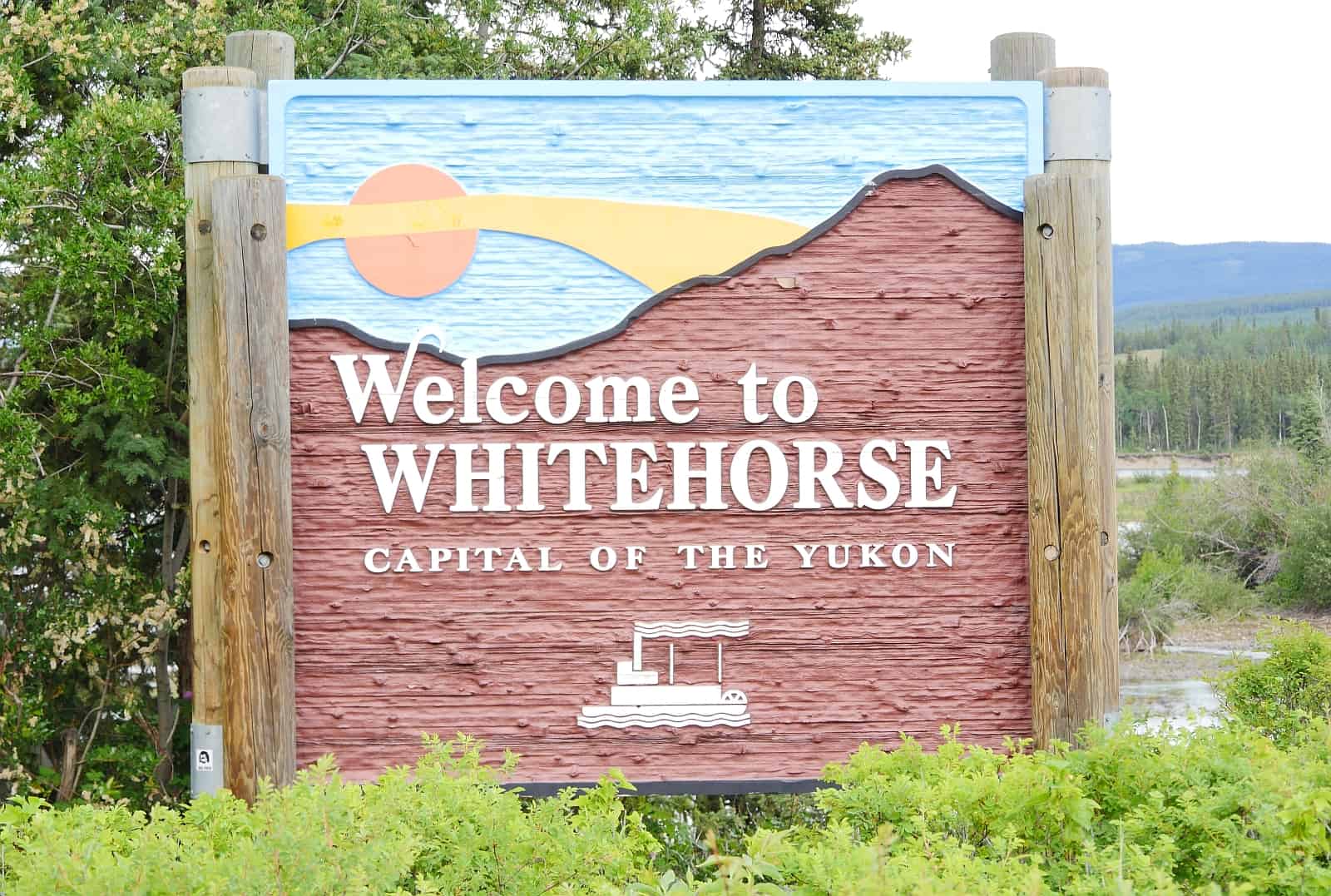
Yukon’s slogan is “Larger than Life”, and the numbers back it up. The territory is bigger than California but has fewer than 50,000 residents, and about two thirds of them live in Whitehorse. The city takes its name from the rapids on the Yukon River, whose white foam reminded the stampeders of a horse’s mane. A dam drowned the rapids in the 1950s, but the river still runs right past downtown and shapes the city in every season.
Here are ten places worth your time in and around Whitehorse, from canyon walks to museums and a hot spring. Prices are in Canadian dollars (CAD), as of October 2026.
Getting There and Getting Around
Erik Nielsen Whitehorse International Airport is about 5 kilometres from downtown. Air North and Air Canada fly in from Vancouver and other Canadian cities. If you are driving, Whitehorse sits on the Alaska Highway and the Klondike Highway. Our guide to Yukon highways has the distances, surfaces and fuel stops for every route.
Downtown, along the river, is easy to walk. For Miles Canyon, the Wildlife Preserve and the hot springs you need a car or a tour.
Best Time to Visit
From June to August the sun barely sets, and most attractions run their full summer hours. From late August to April, Whitehorse is one of the most reliable places in Canada to see the northern lights. Winter brings temperatures that can drop below minus 30 °C, dog sledding, and in February the Yukon Sourdough Rendezvous festival. Several sights on this list are closed or keep short hours outside summer, so check the details below.
1. Miles Canyon and the Robert Lowe Suspension Bridge

Above Schwatka Lake, the Yukon River squeezes through a narrow gap between basalt walls. Frederick Schwatka named the canyon in 1883 after General Nelson Miles. When the spring meltwater pushes through, you get an idea of what the stampeders faced here on their way to the Klondike.
The canyon is also a window into the volcanic past of the region. The basalt columns formed from ancient lava flows, and they are easiest to see at low water in spring. There are more traces of old volcanoes around Whitehorse, such as the Alligator Lake volcanic complex.

The Robert Lowe Suspension Bridge crosses the canyon. Built in 1922, it is named after a transport operator and politician who came to Yukon in 1899. Trails run along both sides of the river. The canyon is about 9 kilometres south of downtown, off the South Access Road. Admission is free.
2. Canyon City

Not much is left of Canyon City, a gold rush settlement upstream at the head of Miles Canyon, but the walk there from the bridge is one of the nicest in Whitehorse. Long before the gold rush, First Nations people fished for salmon above and below the canyon and dried them for winter.
In 1898 thousands of stampeders arrived here by boat from the lakes at the head of the Yukon River. Ahead lay Miles Canyon and the Whitehorse Rapids. Hundreds of boats were wrecked, and several people drowned, before Superintendent Sam Steele of the North-West Mounted Police ordered that only qualified pilots could take boats through. Others unloaded their gear in Canyon City and sent it around the rapids on horse-drawn tramways with wooden rails. When the White Pass & Yukon Route railway reached Whitehorse in 1900, Canyon City was no longer needed and soon fell apart. Archaeologists still work at the site.

GetYourGuide lists city tours, wildlife and hot springs trips and northern lights tours from Whitehorse.
3. Whitehorse Rapids Fishway

Every summer, chinook salmon swim almost 3,000 kilometres up the Yukon River from the Bering Sea to spawn where they were born. When Whitehorse replaced Dawson City as the capital in the 1950s, a hydro dam was built here, and Schwatka Lake flooded the rapids. The planners saw that the dam would cut off the salmon run, which the First Nations depend on, and built a fish ladder around it. Yukon Energy calls it the longest wooden fish ladder in the world.
Halfway up there is a viewing area with windows into the ladder, where you can watch the salmon pass. Staff count the fish and record their sex and condition. Since 1984 a hatchery next door has taken eggs and milt from some of the returning fish and released the young salmon a year later. The hatchery also raises fish to stock lakes in southern Yukon.
The fish ladder is open in summer while the salmon are running, usually from late July into early September. It is at the end of Nisutlin Drive in Riverdale. Check hours on yukonenergy.ca (opens in a new tab).
4. S.S. Klondike National Historic Site

The sternwheeler S.S. Klondike sits on the riverbank at the south end of downtown. Before there were roads, the British Yukon Navigation Company, a subsidiary of the White Pass & Yukon Route, ran passengers and freight between Whitehorse and Dawson City on ships like this one.
The first S.S. Klondike was built in 1929. It carried 50 percent more cargo than the other boats in the fleet and could haul 270 tonnes. In June 1936 it ran aground in the Thirty Mile section of the river and could not be saved. The company salvaged the engines, boilers and much of the equipment and put them into an almost identical ship, the S.S. Klondike II, launched in 1937. It worked the river until 1955, at the end as a cruise boat, because trucks on the new Klondike Highway had taken over the freight.
The ship was later donated to Parks Canada. In 1966 crews moved it through the streets to its current spot, and the slide went more smoothly with soap. It became a National Historic Site in 1967.

Status in 2026: Parks Canada is carrying out a long-term rehabilitation of the ship. The boat and buildings are closed for the 2026 season, but the grounds are open, so you can still walk around it. Check parks.canada.ca (opens in a new tab) before you go.
5. MacBride Museum of Yukon History
The MacBride Museum on the waterfront at Front Street covers Yukon history from First Nations life to the gold rush and the Alaska Highway. Its collection includes Sam McGee’s cabin. Admission is 12 CAD for adults and 11 CAD for seniors, students and youth 13 and older. Children under 12 get in free with a paying adult. The museum is open all year. Winter hours are Tuesday to Saturday, 10:30 am to 5 pm.
Tours of the MacBride Roundhouse are included in admission. In summer the museum also runs the Waterfront Trolley along the river for 3 CAD a ride. The 2026 trolley season has ended. Current hours are on macbridemuseum.com (opens in a new tab).
6. Kwanlin Dün Cultural Centre
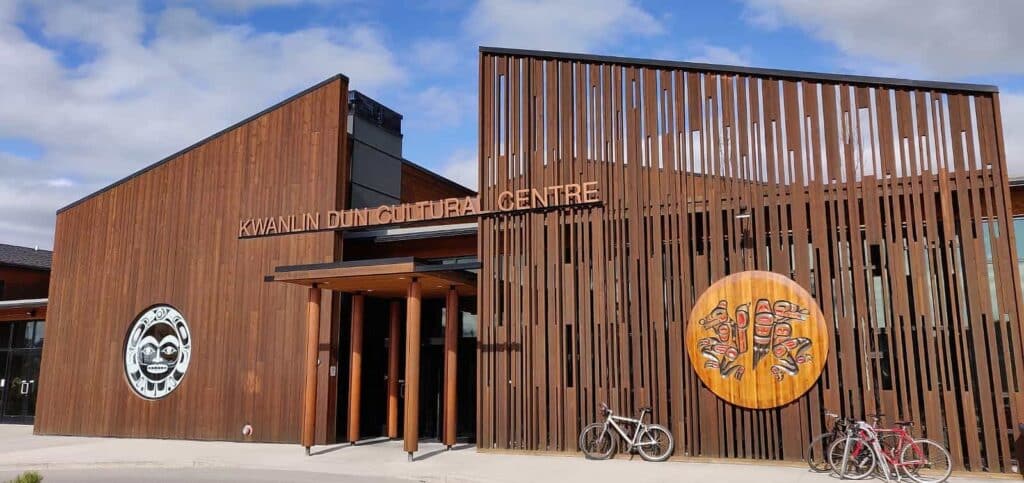
The cultural centre of the Kwanlin Dün First Nation stands on the bank of Chu Nínkwän, the Kwanlin Dün name for the Yukon River. With this building the First Nation returned to the waterfront where their ancestors lived for thousands of years. The centre keeps their heritage alive and hosts exhibitions, events and gatherings. Check the Kwanlin Dün Cultural Centre website (opens in a new tab) for what is on during your visit.
7. Old Log Church Museum

When William Bompas, the first Anglican bishop of Yukon, came to the growing town, he decided it needed a church. Reverend Richard Bowen built a log church and rectory at the turn of the century. Both still stand on their original lots and are among the oldest buildings in Whitehorse.
The church served the townspeople, travellers and, in the 1940s, the soldiers building the Alaska Highway. From 1953 to 1960 it was the cathedral of the diocese, until a new building replaced it. It has been a museum since 1962. The collection of more than 4,500 objects covers over 150 years of church history in Yukon, starting in 1861, decades before the gold rush.

The museum is at Third Avenue and Elliott Street. It is open daily from mid-May to early September, and by appointment in winter. Call 867-668-2555 for hours and admission.
8. Yukon Beringia Interpretive Centre

The Beringia Centre, next to the airport on the Alaska Highway, opened in 1997. It is about Beringia, the land that connected Siberia and Alaska during the Ice Ages, when sea levels were much lower. Large parts of Yukon stayed free of ice and became a refuge for animals and early people.
The most important finds come from the Klondike goldfields and from the area of the Vuntut Gwitchin First Nation near Old Crow. Bones of woolly mammoths, mastodons, scimitar cats, giant beavers, ground sloths and camels have turned up there. Dioramas and full skeletons show what these animals looked like.
Admission is 6 CAD for adults, 5 CAD for seniors and 4 CAD for students and children aged 4 and up. A combination pass with the Yukon Transportation Museum next door costs 12 CAD. From October 2026 to April 2027 the centre is open Saturday to Monday, 12 pm to 5 pm. Summer hours are longer; see beringia.com (opens in a new tab).
9. Yukon Wildlife Preserve

The Yukon Wildlife Preserve shows Yukon’s landscapes and animals on a few square kilometres of hills, meadows and wetlands. It was founded by Danny Nowlan, who flew over the area as a fire spotter in the 1960s and saw that the mix of rocky slopes, marsh and grassland suited moose, sheep and waterbirds. You can see moose, wood bison, caribou, elk, mountain goats, thinhorn sheep, muskox, foxes and lynx in large enclosures. The preserve also cares for injured and orphaned animals and prepares some of them for release.
A 5-kilometre loop trail leads through the grounds. Admission is 20 CAD for adults and 13 CAD for youth aged 4 to 18, and seniors get 10 percent off. A 90-minute guided bus tour costs 32 CAD for adults and 25 CAD for youth, including admission. Book the bus tour online in advance. The preserve is open daily from 10 am to 6 pm, and from November 1 from 11 am to 5 pm. It is about 30 minutes by car from downtown. Details on yukonwildlife.ca (opens in a new tab).
10. Eclipse Nordic Hot Springs

About 28 kilometres from the airport, on Takhini Hot Springs Road, a natural hot spring rises from the ground. First Nations used it long before the first settlers came, and during the construction of the Alaska Highway US Army soldiers built the first pool here from wood and canvas. For decades it was known as Takhini Hot Springs.
Rainwater and snowmelt seep deep into the ground, pick up minerals and heat up before they return to the surface. The water carries calcium, magnesium, sodium and iron, and unlike many hot springs it hardly smells of sulphur.
The old pools have been demolished. On the same site, the owners opened Eclipse Nordic Hot Springs in 2022, a spa in the Scandinavian and Japanese onsen style. It has four rock pools fed by the spring, saunas, steam rooms, cold plunges and a café. Sitting in hot water at minus 30 °C under the northern lights is one of the best ways to end a winter day in Yukon.
Admission is 70 CAD, or 65 CAD on Tuesdays, Wednesdays and Thursdays. Towels and robes cost extra. Guests must be 19 or older. Eclipse is open daily from 9 am to 10:30 pm, with last entry at 8:20 pm. Book on eclipsenordichotsprings.ca (opens in a new tab).
Frequently asked questions
Can I visit the S.S. Klondike in 2026?
Not inside. Parks Canada has closed the boat and buildings for the 2026 season because of rehabilitation work. The grounds are open, so you can see the ship from the outside.
Is the Takhini Hot Springs still open?
The old Takhini Hot Springs facility is gone. Eclipse Nordic Hot Springs opened on the same site in 2022. It is for adults 19 and older, and admission is 70 CAD (65 CAD Tuesday to Thursday).
How much time do I need in Whitehorse?
Two full days cover the sights on this list. Add a day if you want to visit the Wildlife Preserve and the hot springs at a relaxed pace, or a few nights in winter for the northern lights.
Which Whitehorse attractions are free?
Miles Canyon, the Robert Lowe Suspension Bridge, the walk to Canyon City and the grounds of the S.S. Klondike are free. Children under 12 get into the MacBride Museum free with a paying adult.
Do I need a car in Whitehorse?
Not downtown. For Miles Canyon, the Yukon Wildlife Preserve and Eclipse Nordic Hot Springs you need a car, a taxi or a tour.
Comments
No comments yet. Questions about this article are welcome.
Thank you. Your comment will appear once we have checked it.